A whole new digital world

When I first tried virtual reality, it was with an HTC Vive headset on my desktop computer. I don’t think I’ve ever had as much fun picking things up and throwing them. VR was like I was a child again, learning how to walk and interact with the world. I had been so conditioned and so accustomed to playing with a certain set of game rules (a la third and first person action games) that when VR let me shatter them, I was like a newborn child. Even the simple act of looking in one direction and shooting in another blew my mind.

If I were to tell most people that I spent the afternoon playing with blocks, popping bubbles and cooking on a toy kitchen set, they would probably nervously laugh and slowly back away. But until you’ve actually put on a headset and picked up the controllers, you don’t fully understand how eye-opening the VR experience can be.

Since the Vive, I’ve transitioned to PlayStation VR, and while I haven’t played with it as much. I’ve been perfectly happy just wearing the headset and playing my conventional games on a huge virtual cinema screen.

We’re in a golden age of VR right now, because it’s new, fresh and untested. You might as well get in and enjoy the new technology now companies right now are figuring out that this is the next big thing and are trying to figure out howto enter this market themselves. And that means ads, sponsors and a whole host of other digital communication methods.

If you’ve read the book Ready Player One or watched the film adaptation, a good example of what I’m picturing is what the evil company IOI wanted to turn the Oasis virtual world into. A magical place locked by a vault of paywalls and premium subscriptions. And it’s completely reasonable that this might happen,just take a look at what’s currently happening with digital media.

More and more companies are putting their content behind paywalls or behind sponsored ads. YouTube even has an effective way of incentivizing creators to run ads on their content by paying them as mall (emphasis on small) portion of the ad proceeds. It’s just a matter of time before companies find a financially viable way to inject this into virtual reality.

Right now, the hardware to use virtual reality IS the paywall. I’m not talking about the basic VR headsets that Google or Samsung putout, I’m talking the actual interactive VR sets, such as Oculus, Vive and PSVR.The PSVR alone is $200 for the basic unit, not including the original investment cost of a PlayStation 4.

But, the PSVR is a step in the right direction for accessibility, and soon it’ll be even easier for people to have a VR headset.And when it becomes accessible, companies will want to use it for marketing and messaging.

Even now, ads are becoming more interactive and people are relying on the consumers of media to drive the ad experience. What better way than with a virtual reality world where it’s fun to even just use basic human functions?

We’re in the period of this emerging technology where it’s crossing over from the experimentation phase to the commercialization phase. Where companies realize
“oh crap, we should probably get on this train before it’s too late”. Even Apple, a company that’s notorious for not playing nice with other tech, announced their first line of VR-ready computers early last year (2017).

But, while it’s slow going, this is the future. And even now, more people are looking past just video games and entertainment and more towards other applications of VR and AR.

Even now, Google released enhanced Augmented Reality stickers with the launch of their new Pixel 3 phone line. And key within that announcement was Marvel Avengers and Childish Gambino themed stickers. What better way to promote your content than by the consumers thinking that your ads a cool new feature they can share with their friends? If I have fun using basic motor functions in VR, imagine how it easy it will be to create targeted interactive ads for these new media consumers?

The line between marketing and messaging is rapidly becoming fuzzy, just like the line between the virtual and physical world is as well. Mixed reality, virtual reality, augmented reality, we’ve saturated reality to the point that we want to bleed into other dimensions. And that includes everything bleeding into those new dimensions, not just the good but also the bad.

NOTE:

This month I will be finishing up the course in my graduate school that required these blog posts. I’ll continue to try and post on this blog and write on it, but a lot of posts probably won’t be related to communications or digital communication strategy.If that’s not your jam, then thanks for reading my blog!
Mercenary Journalism

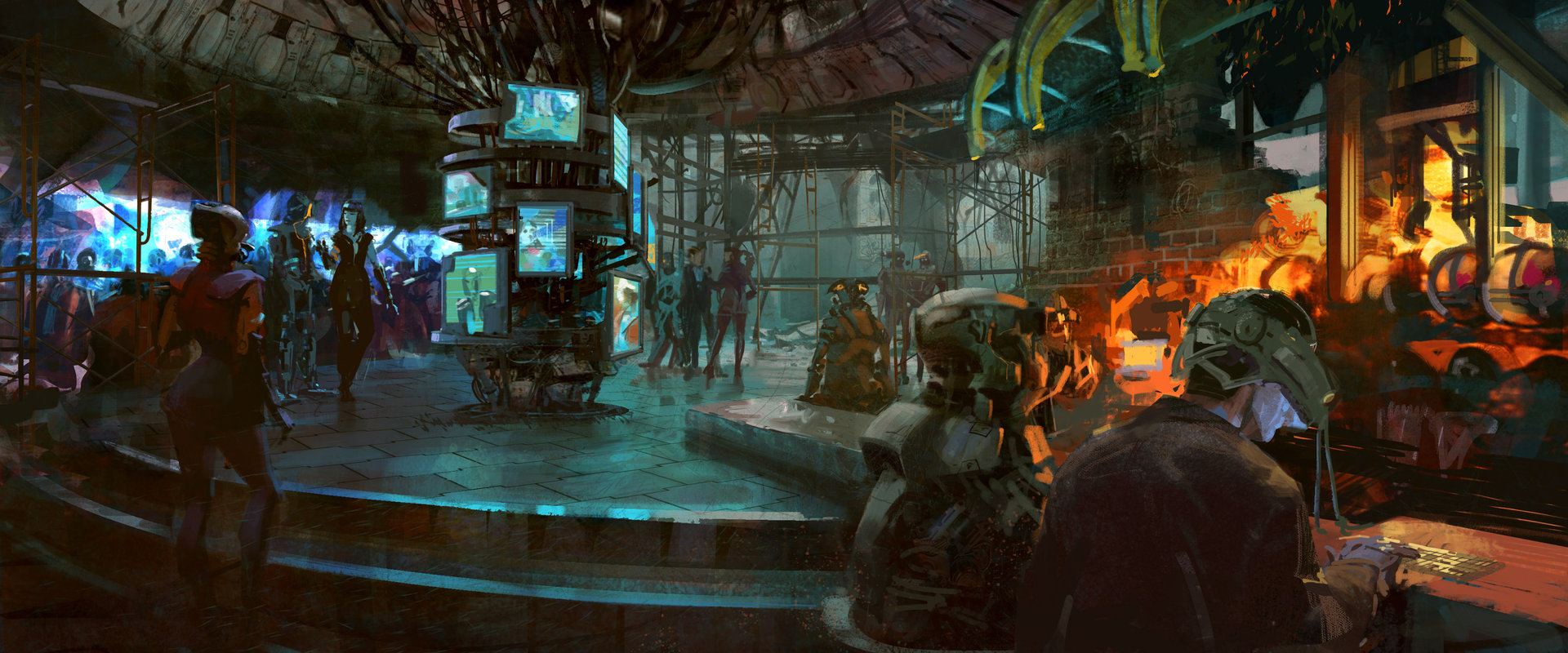
Concept art by Nathanial West
https://www.artstation.com/nathanielwest

A corporate agent walks into a seedy bar. It’s dark, smokey, with twangy country music lazily floating through the air. The bartender eyes the agent cautiously as he wipes a dirty cloth inside a dirtier mug, the well-dressed newcomer a stark contrast to the grungy establishment.

Brushing his shoulder and tightening the grip on the black matte briefcase in his left-hand, the agent eyes the few patrons at the bar before setting his sights on a shadowed figure sitting in the back corner booth. He approaches the figure in confidence, gliding across the sticky floor to close the distance between them as the figure tilts his head lazily up at the agent, his face obscured by shadows cast from the dim lighting. The agent gently clears his throat:

“We’re in need of your services… if you’re interested.”

The figure lets out a raspy chuckle as he slides his cigarette from one corner his mouth to the next, the ashes drifting off the tip to fizzle out as they hit the worn tabletop.

“I thought you guys had it all figured out? That you didn’t need people like us anymore”

“We are in need of your particular…. skills.”

The Agent waves the smoke from the figure’s cigarette and hides a subtle sneer of disgust.

“You have a way with words… and the public has been… resistant”

The man shifts his hand with the briefcase and places it on the table between them with a thud, and slides it across to the figure.

“We’re willing to pay, whatever it takes”

A calloused hand reaches out from the darkness to palm the briefcase, pulling it closer as the clasps pop open with two loud clicks, lifting the top to reveal the rows of bills neatly packaged inside. Letting out a low whistle, the figure laughs and closes the briefcase.

“All right, you’ve got my attention, what’s the job?”

The figure leans forward from the shadows into the light, salt and pepper grey hair adorn his weathered face as his piercing blue eyes contrast his aged appearance. He snuffs out his cigarette on the table, his body slouches in an uncaring expression but tenses as he sees the agent reaches into his breast pocket. From his blazer, the agent pulls out a small bottle of purple liquid and places it next to the briefcase.

“It’s new… grape flavored. We need the public to want it. Sell them on it. All natural cane sugar and eco-friendly packaging.”

The old man reaches forward to grip the bottle and turns it in his hand, studying it before flashing his teeth at the agent in a mischievous grin.

“I think I can help you with that….”

At least…. That’s how I imagine brand journalism to work.

Despite my fantastical (and probably overly dramatic) depiction of how companies and freelance journalists work together, brand journalism is a rising trend in the communications world. More and more companies are looking for people from the news industry or those with a journalistic skill set to push their content to the public.

With the rise of digital communications, companies no longer need traditional news agencies to push their content. Now, companies and corporations can push their content direct to their target audiences. Social media, websites and mailing lists enable businesses and consumers to interact in a direct conversation, cutting out the newspaper middleman. But just because the infrastructure is there, doesn’t mean the companies don’t need individuals with the know-how to tell that company’s story.

Brand Journalism also give journalists a chance to flex their creative muscles in ways that traditional news agencies didn’t allow them to. In an article from Ragan’s PR Daily:

Corporate communications have a prime opportunity to fill gaps amid the smouldering ruins of U.S. journalism….strung-out reports struggling under incessant page-view and productivity pressure are more open to contributions from atypical sources…many publications or papers would be delighted to use your story as source material.


http://m.prdaily.com/Main/Articles/4_reasons_to_take_the_plunge_into_brand_journalism_25091.aspx

It’s a rising trend that both empowers freelance journalists and enhances the communications toolkit that companies have. It seems like a symbiotic relationship that will only continue to grow and develop over time. This seems especially true with the pending death of net neutrality and a more corporate controlled internet.

But… is brand journalism a good thing?

While it can definitely be beneficial for companies and businesses to have a news team in their pocket or on retainer, it gives off a sort of “mercenary journalism” vibe to those who deal in this side of the industry.

One of the guiding principles of the news businesses seems to objectivity and a dedication to reporting on the facts, without bias or outside influence. To offer oneself as an agent or advocate for a third-party or financially motivated entity seems to contrast with the typical mission of a reporter. Could one even call themselves a reporter after working in brand journalism?

In the article that I quoted earlier, it states all the reasons why people should take the plunge into brand journalism:

  • It’s a good way to attract staffers
  • It’s a great way to rise against competitors and capitalize on the current media environment
  • It’s more interesting for your company and your audience
  • It’s empowering for your company and your employees

These are great reasons to invest in brand journalism…. but they’re all beneficial from the standpoint of the company. Nowhere does this article state the benefits it provides to the journalist. If you search other articles, a lot of reasons include professional networking, steady income and creative freedom.

While I can’t say I’ll always agree on the last reason, I also say that a lot of those reasons are from the perspective of the company needing the brand journalist.

Perhaps, I’m naive and romantic, and the idea of journalists as the watchdogs of the public is a dying ideal. As things begin to become more and more financially motivated, is it enough to have an idea of objectivity to stand against the need for a cash-flow to sustain your operations? In the end, when news companies are taking information from brand journalists and taking revenue from corporate advertising, perhaps the only person that can look out for you is you.

Brand journalism isn’t a bad thing by any means, and for those who aren’t as attached to the idea of a investigative reporter, it can be a great field to break into and broaden your communicative skills. But I can’t help but think of this industry as mercenaries of the communications world, willing to sell their skills to the highest bidder.

As we enter an age where companies no longer need a middle man to communicate their message, perhaps it’s also true that consumers no longer need a middle man to protect them. Perhaps it’s time for the consumers to protect themselves.

Then again, if I was wary of brand journalism, perhaps I shouldn’t portray them as super cool mercenaries for hire. Maybe my next blog post will be about the virtue of Pepsi and their cool, refreshing beverages.

(This blog post not brought to you by anybody but me.)

Journalism on Journalists

I’ve worked in offices that provided photo and video services for a few years now, and I can’t count the number of times where unrealistic requests have been brought to us with unreasonable deadlines. Or the number of times when videos and photos are returned to us and asked to be changed because they think there’s a better way to do it. Or even the number of meetings where I’ve had to justify why my office needed to exist in the first place. 

“Why will it take so long? It’s just a group photo”
“Can’t you just make this video by tomorrow?”
“This video needs more explosions”
“Can you just green-screen this in?”
“Do we really need three photographers? I’ve got a camera in my phone right here”

Working in a creative field can be frustrating.

For a lot of reasons, but primarily because there is no singular way to be creative. It’s all subjective. What works for one person doesn’t work for another. Some like elegant prose, some want their stories short and succinct. Someone may love the use of jump cuts in their videos, others see it as a mark of poor videography.

Regardless of how you do something in a creative industry, there will be people who disagree with your methods or style. 100% of people will never 100% like your work.

However, it’s okay to disagree! I feel should clarify this point. Disagreement  is part of what makes creative fields so great. All the different creative perspectives constantly drives people to create and design new methods and styles. People have perspective that will allow them to create in ways that others could never have dreamed of, and it’s only through open discussion that these different spheres of influence can meet and mingle. There’s absolutely nothing wrong with creative and constructive criticism.

My frustration however, comes from the fact that EVERYBODY has an opinion, and everybody has a “better” way of doing things. And when everybody thinks they can do something, suddenly that thing doesn’t seem so special anymore. 

The problem with these critiques is the sense of entitlement that usually comes along with it. The “must haves” and “ASAPs” that often only come from someone who thinks that they have an equal hand in the knowledge base. With it being so easy to pick up a phone and shoot a video and upload it to Facebook or YouTube, why should people have to pay for a similar service?

This is a problem that a lot of people in the journalism industry are facing these days. This is the cursed side of the double-edged sword of the internet and digital communication.

The internet has brought along a golden opportunity for the journalism industry. Never before have journalists had such easy and open access to their public and their audiences. Opinion polls are easier than ever with platforms like Twitter. Interviews can be done across the globe thanks to Skype, Facetime or Google Duo. 

Stories are no longer fire-and-forget pieces, oftentimes the hardest work now comes after the content is posted. People from around the world can see posted content in seconds, and share their personal and professional opinions just as quickly. Journalists can now engage in the discussion and maybe even come across a few new stories in the process.

These advancements in technology aren’t just limited to an elite cult of “journalists” either. Almost anybody can use these tools these days. Camera and video technology is more accessible than ever, and the amount of online resources and websites that allow people to share content is ever-expanding. 

Here’s the downside.

While all these advancements bring about a golden age of communication, it also brings about a misconception as to what journalism actually is.

Anyone can go out and record something with their phone and put it online. Anyone can conduct an online poll, and almost anyone can get an interview from someone via Twitter or Facebook. But is that actually journalism?

The communications industry has actually helped exacerbate the problem in my opinion, by legitimizing and spreading the term of “citizen journalism” around. Journalists are no longer competing with fellow peers to break the latest story, they’re now competing with almost everybody in the world. 

One could argue that journalists will always have the advantage because they represent credible news organizations and come from big-names like CNN or BBC. But what about those small-town agencies? And with how easy and casual practice it is to share links and content, do people really care about credibility anymore?

If a fire breaks out downtown, do you care if the footage comes from your local news station or do you care that you can see it on the Facebook live-stream of your buddy who happened to be eating a burger across the street?

This is the biggest problem facing journalism these days

CREDIBILITY

Journalists are struggling to find a way to maintain their journalistic integrity while avoiding succumbing to the same level of quality as every amateur v/b logger out there (myself included in that crowd).

Journalism isn’t dying, it’s evolving. But is it evolving fast enough? This creative industry is racing against the entire world to prove itself as a professional occupation and to prove that journalists are still needed.

There’s nothing wrong with “citizen journalists”, and when used correctly, they can be an amazing weapon in the news industry’s arsenal. But unlike news stations, nobody is fact-checking these news mercenaries. And like any good weapon, these resources needs to be inspected, checked and reviewed for quality on a regular basis. 

As for the fact that anyone can do it? Maybe they can (with a few stipulations), but first I think journalists need to do a better job reporting on themselves.

I think that the reason these misconceptions exist and these unreasonable requests for creative services exist is because people don’t understand the “behind the scenes” work. They’ve been so exposed to the flashy marketing of web developers and phone companies that want you to buy the latest GoPro or design your own website. They don’t know what goes on behind the curtain. They’ve waded into the creative kiddie pool but don’t know what goes on in the deep end.

Maybe if journalists can show people what they do in a way that’s engaging and appealing, people will begin to understand why the world will still need professional journalists.

Or maybe they’ll just want more explosions in their news stories. 

Do Not Pass GO

Monopoly was a fun game when I was a kid. A little infuriating sure, but family fun nonetheless. I’m going to go as far as to say that it was an educational game too. It taught me how to manage my money and how it was bad spend outside your limits; most importantly, it taught me not to trust my dad with property deed cards when I wasn’t looking. 

All in all though, Monopoly brought me happy childhood memories, and I don’t think I ever gleaned the board game’s true meaning until I was much older (which is that monopolies are bad by the way). And I think that to a lot of people today, “Monopoly” still means nothing more than a board game that now has way too many themed editions.

However, monopolies are a huge problem, probably even more so now than they were during early America. The resources and tools of the digital age have given large companies and corporations an endless supply of loopholes and shortcuts in order to hide their monopolistic desires. If the internet is the “Wild West”, then large companies are those pioneers obsessed with manifest destiny, ready to come and bring order to a “unorganized” media landscape. 

I bring up the topic of monopolies because of a recent case study I had to read for my Graduate School. In 2014, the Federal Communications Commission reported that ethnic/racial minorities owned just 3% of the 1386 full-power commercial broadcast T.V. stations in the United States.

THREE PERCENT?!

That’s a ridiculously low number, and while there are a lot of shows on television these days that have minority characters or tell minority stories, a large part of the ownership behind those shows and stations are white and male. And to be frank, a lot of those shows out there are pretty poor representations of the cultures they’re based around.

Now I want to cut off any social justice comments at the pass and say that there’s nothing wrong with being white and male (despite what a lot of the internet says).

However, I do think there’s a problem when the only voices out there making the decisions are white and male. 

Ignoring the international aspect of this issue and focusing solely on the intra-national, America is a melting pot, and America is great because of the wide variety of cultural influences that it’s citizens bring to the table.

Diversity is GOOD

It brings perspective, empathy, and drives people to compete, which in turn leads to innovation.

But there’s going to be a problem when most of the primary ways that Americans get their entertainment and information is directed and managed by a homogeneous population.

And now we’re living in a society where 6 major companies own almost every form of media out there in America:
(Source: https://www.webpagefx.com/data/the-6-companies-that-own-almost-all-media/)

-National Amusements (MTV, BET, CBS, Metacritic, etc.)
-Disney 
-Time Warner
-Comcast
-News Corps (Fox)
-Sony

Out of all 6 of those companies, all 6 CEO/Owners are males, and only one them is Asian; the president of Sony, Kazuo Hirai. Even then, he owns the smallest share of the 6 companies ($34.1 billion compared to Comcast’s $148.2 billion). 

My point is this:
Diversity drives innovation and progress.

When diversity is introduced to any mixture, there are different, and sometimes conflicting, viewpoints. And when there are multiple parties and people competing for attention (or market-share), then people innovate and try to sell themselves to the public harder. And as a result of this, the consumer will benefit with a better overall end experience. 

According the case study I read, the FCC made some moves in 2014 to try and prevent broadcasting companies from controlling more assets, but it’s not enough. With the repeal of net neutrality and the death of a free internet on the horizon, we need to have more diversity in that corporate sphere.

When everybody is on the same page and has the same opinion; sure, it’s nice and stress-free. But you know what it also is? BORING.

And it just means that it’ll be that much harder for what minorities are left to get their word in edgewise. We need to stop thinking of “Monopoly” as a board game that ends friendships and start thinking of “Monopoly” as a real world issue that will end innovation. 

Unless you like watching a different iteration of the Brady Bunch until the end of time.

Whose Data is it Anyways?

I’m a sucker for a well-designed app.

I usually tend to tinker with and try a few different apps each week. My search results are full of variations of “top [insert category here] apps”.

I’m such a sap for these sleek, shiny programs that I often am willing to give them way more information than I usually intend to. And trying out these apps usually always follows the same process:

*Install, review terms of service, see what information it wants to gather, sigh and then uninstall*.

I like to think of myself as a relatively security conscious person. I have strong passwords, I don’t save my login on public computers, I use VPN (virtual private networks) when I’m in public, all that jazz. But that’s all built to keep threats out. People or programs that want to kick down my digital door and steal my information.

What I’m usually the most concerned with is the data that I am choosing to give companies, and the implicit trust I put in them to handle that data safely and ethically (most of the time just because they have a slick menu).

A lot of us like to think that we’re secure with our data, and don’t consider the possibility of the data being misused by the people we’re providing it to. We’re so focused on the external threat that we often forget that most data issues and breaches are a result of user error.

What happens when we open the drawbridge to our digital castle and let the armies march right in? But here’s the thing;

Do we really have a choice when it comes to whether or not to trust companies and organizations with our data?

There are so many applications that are so critical to people’s daily lives. E-mail, calendars, bank accounts, social media, etc.

To avoid the use of these technologies because we’re worried about data abuse would turn us into the online equivalent of that one person in the long checkout line that wants to pay by check (or pennies).

Should we really have to choose between being technological cavemen or open door digitens (my made up word for digital citizens)?

If you’re unfamiliar with the recent Cambridge Analytica Facebook Scandal, you should check out the following article from The Atlantic below that gives a solid gist of the issue:

(I promise, it’s a short read)

There’s a lot behind the scandal itself, but the general point that stands out to me is this:

“What do we do when the services that are so integrated to our normal lives can’t even be trusted to protect our data?”

Is there even such a thing as being data-safety conscious in our personal lives when we willingly give everything to these companies anyways?

What’s the point of having security questions and two-step authentication if the companies that are moderating these measures are the potential threats? At a certain point, are the countermeasures or steps we’re taking for nothing more than giving us the illusion of safety?

I encounter a good example of this issue everyday.

As I’ve said before, I try to be security conscious. I’ve heard of Google having some data and privacy issues lately, so maybe I don’t want to use G-mail anymore. Maybe I want to try a different browser than Chrome, maybe I don’t want to search everything via Google.

So I install Brave, a solid privacy browser from a splinter of the Mozilla team. I use Duck Duck Go as my search engine, and I start using Outlook instead of Gmail as my e-mail app.

These all sound like solid alternatives right?

The problem is….

I HAVE A GOOGLE PHONE…. ON A GOOGLE CELL NETWORK.

black google smartphone on box
Photo by Deepanker Verma on Pexels.com

And as much as I’m concerned with my privacy, I’m not about to go sell my phone (that’s a key part of my personal and professional life) for a flip-phone or some pay-by-the-month burner. And the other alternative to a phone system is Apple, which has it’s own share of company issues.

Some people may argue that a phone isn’t essential to living, and that you have to make some sacrifices of convenience to be private in today’s age. And for the most part, that’s true.

But as someone who works in digital communications, this hardware and the apps that come with it are essential to my personal and professional development.

I talk to my friends and family on it, I manage my money on it, I handle my graduate school on it, my professional network knows to reach me on it. Even just to create personal and professional versions of all of my systems does nothing more than doubles the amount of data that I have to manage and filter.

To sever all of that or take the time to move to a different digital ecosystem is a transition cost that many, including myself, can’t afford.

And what do we do when those who are supposed to hold these companies accountable don’t even have a fundamental understanding of how these programs and digital cultures work?

(See the below video for a solid summary of the Facebook senate hearings).

In fact, all you have to do is search “Facebook senate hearings” on Youtube. (the second suggestion is “Facebook Senate Hearings Funny”) to get a feel for how the general public reacted to this particular issue.

In today’s age of digital convergence and technological advancements, there is a certain level of risk that we all have to understand and accept if we want to maintain our current lifestyle.

Unfortunately, if you’re looking for a solution to this issue of data privacy I don’t have one.
I still try alternative email clients and I’ll turn off tracking in my browser. But I’ll also still continue to save my payment information on Amazon and use GMail as my primary e-mail address. These are the risks that I choose to accept.

You could hope that a third-party organization out there can create some buffer to protect your data from the bigger corporations. But what’s to say that they’ll be ethical and responsible with your data as well?

To be truly private is impractical, and almost impossible without building your own platforms yourself. But it’ll be a long time until that imbalance is overcome, and until then, you as a digital citizen have to be able to answer the question.

How much risk are you willing to accept to live in the future?


Field of Flowers, Field of Thorns

Who likes flowers?

They’re nice, they’re colorful, and they smell really good. There’s often lots of BEES.

animal bee bloom blooming
Which is a good or a bad thing depending on your viewpoint of bees. (Photo by Pixabay on Pexels.com)

And it’s a beautiful site to see a rainbow of flowers growing in someone’s backyard or in the countryside.

But who likes weeds? They’re hard to get rid of, they can ruin other plants, they’re usually not very good looking, and sometimes they can even hurt you if you touch or step on them the wrong way.

That’s why people often have gardens. To grow the pretty and useful plants they want and keep out the bad ones. Its nature, domesticated, and a beautiful yard can be the pride of the neighborhood.

But what happens to the weeds that are left neglected? They often run rampant through the countryside or woods, spread across the ground and choking out the flowers and other plants that just want to grow and engage in the amazing process of

spongebob-photosynthesis
(Source: Spongebob Television. Artist Rendering by: Angela Natividad)

You might wonder what any of this has to do with the internet or communications, and maybe I’m going metaphor crazy, but take the image I just describe, and instead of a garden, think about Facebook or Twitter. The internet is the land and the people are the plants.

This all relates to the topic of the “digital divide”, a fancy term for those who have access to technology, and those that don’t. There’s been a lot of talk of how the digital divide segregates people on the internet. More and more digital assets are being put behind paywalls and memberships. Virtual gated communities or private digital gardens are emerging; and as much as many don’t want to admit it, the age of the free internet seems to be slowly dying, and now that people have realized there’s money to be had online, companies and businesses are eager to commercialize it.

Amazon Prime, Spotify Premium, Hulu, Netflix, Crunchyroll, Reddit Gold, PlayStation Plus, Xbox Gold. Everything has a membership and a cost these days.

Free is becoming “freemium”, if not premium, and everything is becoming pay-to-play.

In my mind, one of the best examples of the digital divide and an internet freemium economy is within the world of video games. More and more people are being separated between loot boxes and customization items. Those who can afford to purchase custom skins and weapons treat those who can’t afford it differently. Some games are even allowing you to purchase in-game progress instead of earning it through battle.

Companies are teaching people that the easiest and fastest way to overcome a problem or obstacle is to throw money at it.

If you can afford it, great, welcome to the new digital utopia. Your own personal private garden curated of all the flowers you want and all the weeds you don’t.

But what if you can’t?

A culture is rising of the internet “poor”. Those who can’t access or utilize the internet’s best because they either can’t afford it or can’t understand it. As popular social media platforms are becoming more and more discerning of what’s allowed on their platform, more and more people on the disadvantaged side of the digital divide are falling to the wayside. Alongside those virtual private gardens are digital plots of dirt.

Many people criticize social media platforms as a contributor to this problem. But is social media really the bad guy? (aside from all the privacy and data selling concerns…)
Many people bring up the issue of freedom of speech when it comes to social media.

Why can’t I say what I want, when I want to?” “What about my cabbages!” “What right does [insert website here] have to control my content?”

These are fair questions, but a lot of people seem to forget that it’s not their personal garden or playground. Those platforms are responsible for what people say and do on them. Social media isn’t a private garden, it’s a community garden; they own the land and we just plant what we want. But as owners of the land, they can set rules and boundaries as to what’s allowed to grow and what’s not.

But while their business model is letting people choose what they want to grow (or communicate), we’re all very quick to pick up our internet pitchforks and torches whenever someone else says or grows something that we don’t like.

“How could you let this person say these things?” “How come you’re not shutting down this page? Who eats Brussels sprouts?! Don’t you SEE what they’re putting out there?!”

When you get these two extremely polarizing sides shouting at a platform, the platform is going to do what’s best for its business. So what happens to those individuals who say things that others don’t like and get forced off those mainstream platforms?

They make their own platform or community garden and grow whatever they want. Brussels sprouts, eggplant, mushrooms, you name it.

These days, anyone can create a social platform, or a website, or a blog to talk about whatever they want to talk about. They’re more than welcome to. They won’t have the polish, or support, or capabilities that larger platforms like Facebook and Twitter do, but they’ll have less restrictions and be beholden to less as well. The internet allows everybody to grow their audience and message, radicals and moderates alike. All you have to do is a pick a plot of digital land and start planting.

Because we have so many community gardens with their own rules on what you can and can’t grow, the social rejects from pretty mainstream platforms are forced to create their own platforms, or congregate in areas where they’re less controlled or more accepted. And that’s how you end up with a barren plot of dirt or an overgrown garden of weeds. What choice do these individuals have other than to group together with like-minded outcasts?

Social radicalism is all over the internet, just like in real life. But unlike real life, it’s seems a lot more socially acceptable/visible to stuff it all in one dark corner. And when you have these concentrated pockets of radicalism or socially unaccepted viewpoints across the internet, it looks a lot worse than when they’re diluted in the general digital space. It’s hard to spot a thorn in a field of flowers.

A lot of people talk a lot about how “the internet” is allowing these places to exist and how “the internet” creates these negative effects.

But the internet is just a tool, it’s just the dirt that we grow on. What we grow there is our own decision. We are creating our own Frankenstein’s monster. When we perpetuate a culture of “the internet can be what I want, when I want”, a lot of people will stuff the things they “don’t want” into the closet and try to forget about it. They’ll put a fence up and say that it’s not their problem. But we have to take some share of the blame for the rise of these radical eggplant growing internet gardeners.

They're like spongy and flavorless. Ick.
Seriously, I think they’re gross. (Source: https://commons.wikimedia.org)

Don’t get me wrong, I’m not excusing radical social behavior or saying that it’s acceptable by any means (although I’m not a huge fan of eggplant). But I’d feel wrong if I said that we don’t contribute to part of the problem. There is no cyber police force to monitor all of the internet and what happens on it. The FCC and China can try, but the internet transcends national law and regional culture.

As I may have mentioned in earlier posts, the internet is a platform and a hub, it’s a launching point for everyone, both the “crazy” and the “sane”. It’s up to us as citizens of the internet to monitor it and moderate it ourselves. And when we choose not to deal with the radical and choose to build walls and fences around undesirable behavior, all we’re doing is emboldening the problem and letting it grow and grow until it spills over our walls in a much worse than it originally stated.

You know what’s worse than misinformation or hateful thoughts? Misinformation and hateful thoughts that have been fermenting in a vacuum. When those thoughts are ignored rather than addressed, they work in a vicious circle. And those thoughts become cemented in people’s minds and those minds become harder to change. If you pull the head off of a weed, it’ll continue to grow until you treat the “root” of the problem.

For as long as the internet remains as nebulous and unregulated as it is (and as it should stay), there will always be communities of radicals out there. With how easy it is for everyone to have their own platform, people will continue to work to find ways to foster their message and recruit people to their cause. It may not be through Facebook, Twitter or Instagram, and it may be on something less well known, like Gab or WordPress or even a private subreddit, but it will happen.

There’s nothing wrong with growth, and sometimes unregulated growth can be a good thing. But there’s a difference between a field of weeds and a well-tended garden. And all the free land up for grabs out there will continue to allow for all kinds of things to grow:

Good and Bad alike.

The Quest for Fake Internet Points

Judgement from a well-collared person

Likes, shares, retweets, karma, points, subscriptions, pins

There are a lot of different ways to quantify internet success and popularity. Every time I think of the internet and how our culture quantifies popularity, I think of one of my favorite casual watching shows, “Whose line is it anyways?

Every episode, Drew Carrey would open the show with the tagline,

“Welcome to the show where everything’s made up and the points don’t matter.”

That show was really fun and entertaining to me, and I think their concept is part of the draw of social media. Almost everything (or almost everything) is made up and none of the points matter. So mentally, there’s no consequence. It’s a risk-free trial to the good life.

Yet, we place a lot of value on those internet points, and why shouldn’t we? Everybody wants to be part of the cool kid group, wants to be included. And what better way to be included than by doing nothing but laying in bed at 3 pm, flicking your thumb across your phone?

Social media is fun, everyone’s on it, and it’s easy. It’s so easy to get involved that it’s slowly and seamlessly embedded itself and evolved into an essential part of our everyday personal and professional lives.

Almost everybody likes to be in the know. And when you can engage in social media and be part of this conversation across cultures, genders, ages and geographic divides, you feel cool (from a tech achievement, it is cool). You feel like you’re at the popular table at your high school cafeteria. For some, that’s the norm, for others, it’s a dream come true. Social media is a true social equalizer, and that statement alone is intoxicating to some.

Have you ever dreamed about having superpowers? Maybe even the power to stop time?To go back and fix mistakes, change what you said to your crush that one time, review what you want to say before you say it? Social media has the ability to let you do a lot of that.

It’s life, filtered and screened, and gives people the chance to put their best foot forward (or worst, depending on who you follow). Social media in some senses, has evolved into a competition of “who is the best at public relations”, and fake internet points is how we see who is winning.

But for every chance it gives people to put their best food forward and filter themselves, that buffer also absolves people of some of the personal responsibility that comes with social interaction on a more sinister side. And as much as everyone loves to show off the best parts of their lives, everybody also loves drama, and being able to judge on the less desirable aspects of society.

It’s undeniable that a large part of social media’s growth is being able to sit in the digital crowd-stands and eat popcorn while they watch their second-cousin duke it out with their extremist aunt about whose dog is cutest on Facebook. Negativity and drama can (and do) run rampant on social media, some people even make a profit on selling it and marketing it. Facebook has even expanded their comment reactions from simple “likes” to sad and angry faces. Reddit has entire sub-reddits dedicated to things like calling people out on bullshit, or examples of internet justice.

And because anyone can watch like an anonymous voyeur (but not in a creepy way), people are much less likely to stop it. I could go on a rant and go deeper down the rabbit hole of cyber-bullying, but that’s a topic for another time.

My point here is this:

Social media is just as  popular for it’s negative aspects as it is for it’s positive aspects. And because people aren’t trading physical blows, it’s easy to to hide from the confrontation of an unpopular opinion or statement.

And what’s one way to promote these positive and negative experiences than by “smashing that like button”? Or “upvoting something to the front page” or “retweeting” it?

As made up as fake internet points are; when people put value in it, businesses put value in it. Imagined currency becomes real currency and social gatherings become social marketplaces.

With digital convergence comes cultural convergence; businesses and marketplaces are always trying to find ways to inject their values and their products into our everyday interactions.

And why shouldn’t they? It’s smart, it’s quick and it’s effective. And it’s not necessarily a bad thing either.

Social media has become the next platform of social interaction.

It’s become the modern equivalent of walking around your neighborhood; and just like businesses put up flyers and billboards, companies put pop-up and video ads into your newsfeeds. Everyone on social media is trying to “buy” your attention, and the method of payment is your click of a button on whatever quantifiable action the site encourages.

Those fake numbers are what people use to tell you:

HEY…THIS is worth your time.”

Gone are the days of simple AIM, Yahoo or ICQ chats between friends and strangers. To a certain extent, we no longer want that. Social media has grown to become something much more than just a way for people to connect with each other.

It’s become a gathering place. It’s become the local tavern for our digital lives, letting us meet up with friends and strangers alike to take one of the many paths into the internet dungeon for a chance to collect some of that sweet, sweet internet treasure.

It’s made us the judges of our own worlds, and the worlds of others, letting us raise and lower the best informal PR people around us to great heights or deep lows.

That’s a lot power for any one person. And what would Uncle Ben think of that?

Media Literacy

Media Literacy: An understanding of mass media and how they construct meaning.

(Campbell, R., Martin, C. R., & Fabos, B. (2017). Media & Culture Mass Communication in a Digital Age (Eleventh ed.). Boston, MA: Bedford/St. Martin’s.)

There is a lot of information out there on the internet.

Yesterday, on Oct. 9th, 2018, Google had a live keynote where they announced their latest product lineup, to include a new phone, a new google tablet, and a home hub station that I really didn’t care about. Within a few hours, I saw at least 10 different articles from 10 different sources discussing the products, each with their own spin/take on what they got from the announcement. That’s a lot of viewpoints and a lot of facts, and they often contradicted or tried to “one-up” each other.

That was only for one company’s product showcase. Now, apply that same example to pretty much every major (and minor) world event happening every day. It’s easy to become jaded and to shut it out or just not care.

To be honest, for a while, I did just that. I didn’t follow the news, I didn’t care about current events and I couldn’t be bothered to hear the latest celebrity gossip. To a certain degree I still don’t.

But there’s an important difference between a total media blackout and utter cynicism versus a filtering of information using a critical eye. Media literacy is a good term to put to that process.

I’ve learned that I don’t have to shut out the world to avoid all the garbage that litters my info-sphere. I just need to be more discerning and focused in what I want to learn. (There’s a whole different issue about the duty of an individual to stay well-informed but that’s a black hole for another time.)

By analyzing, interpreting and evaluating what I’m reading from different sources, I’m able to more clearly define and identify the truth and the facts of topics that interest me. When I look at these stories, I can identify the major players, the key events and the talking points that correlate across multiple sources. Typically, if I don’t see something stated in at least two other places, it’s usually a good reason to doubt what something is saying.

It’s like if you want to buy a car. Most people don’t just walk onto a lot and purchase the first car they see (if you do, you’re much braver than I am). People look at reviews, they test-drive them, they visit multiple dealerships and often bring friends along to get another perspective. At the end of most car purchases, people feel assured that they’ve made a good decision, because a car is an incredibly important part of their lives. Why should your consumption of information to affect your world view be any different?

Personally, by using the critical analysis process, I find myself more at ease. I’m more confident in knowing what I’m reading and learning about is more likely to be accurate and true. And in a world of uncertainty and misinformation, it helps me better realize where I stand.

Being media literate is not just important to understanding the news of today, but also a solid defense against the encroaching feeling of exhaustion and fatigue that most people feel when they look at the open floodgates of information.