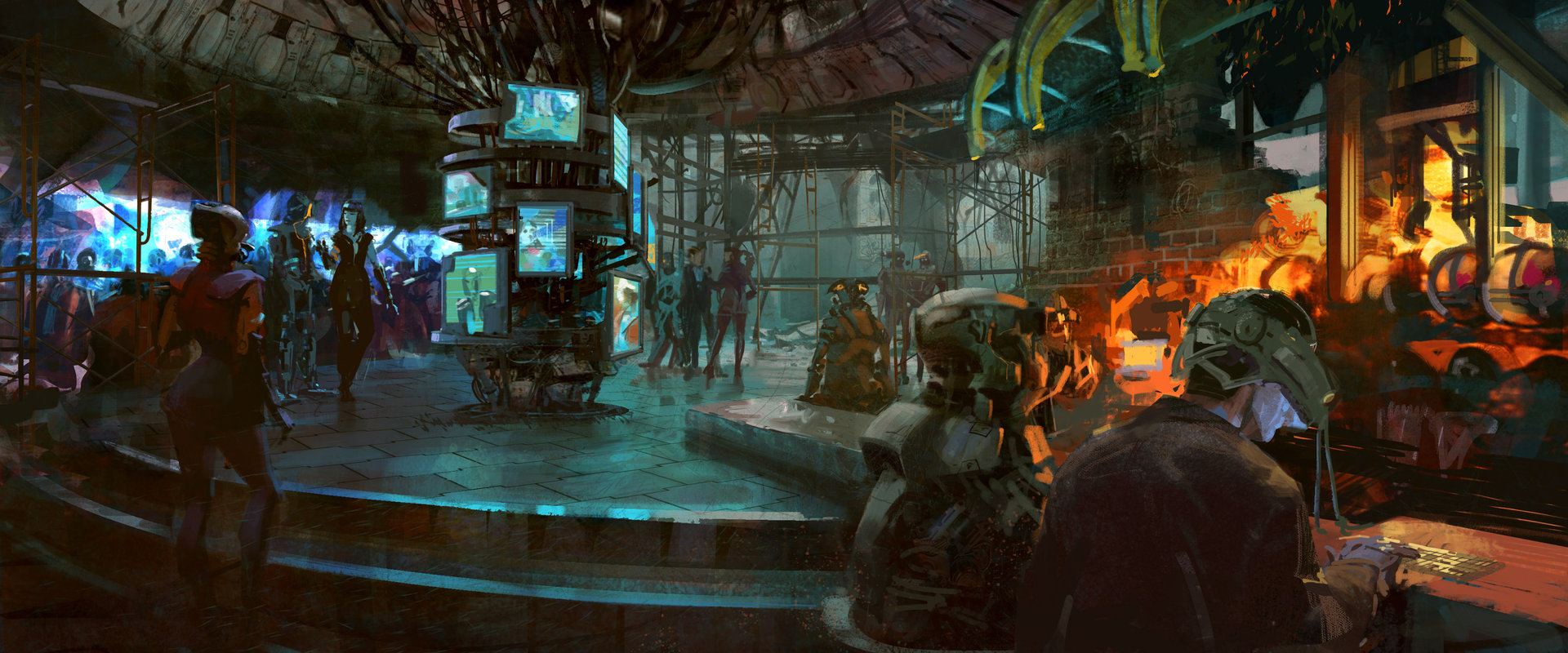
Mercenary Journalism

Concept art by Nathanial West
https://www.artstation.com/nathanielwest

A corporate agent walks into a seedy bar. It’s dark, smokey, with twangy country music lazily floating through the air. The bartender eyes the agent cautiously as he wipes a dirty cloth inside a dirtier mug, the well-dressed newcomer a stark contrast to the grungy establishment.

Brushing his shoulder and tightening the grip on the black matte briefcase in his left-hand, the agent eyes the few patrons at the bar before setting his sights on a shadowed figure sitting in the back corner booth. He approaches the figure in confidence, gliding across the sticky floor to close the distance between them as the figure tilts his head lazily up at the agent, his face obscured by shadows cast from the dim lighting. The agent gently clears his throat:

“We’re in need of your services… if you’re interested.”

The figure lets out a raspy chuckle as he slides his cigarette from one corner his mouth to the next, the ashes drifting off the tip to fizzle out as they hit the worn tabletop.

“I thought you guys had it all figured out? That you didn’t need people like us anymore”

“We are in need of your particular…. skills.”

The Agent waves the smoke from the figure’s cigarette and hides a subtle sneer of disgust.

“You have a way with words… and the public has been… resistant”

The man shifts his hand with the briefcase and places it on the table between them with a thud, and slides it across to the figure.

“We’re willing to pay, whatever it takes”

A calloused hand reaches out from the darkness to palm the briefcase, pulling it closer as the clasps pop open with two loud clicks, lifting the top to reveal the rows of bills neatly packaged inside. Letting out a low whistle, the figure laughs and closes the briefcase.

“All right, you’ve got my attention, what’s the job?”

The figure leans forward from the shadows into the light, salt and pepper grey hair adorn his weathered face as his piercing blue eyes contrast his aged appearance. He snuffs out his cigarette on the table, his body slouches in an uncaring expression but tenses as he sees the agent reaches into his breast pocket. From his blazer, the agent pulls out a small bottle of purple liquid and places it next to the briefcase.

“It’s new… grape flavored. We need the public to want it. Sell them on it. All natural cane sugar and eco-friendly packaging.”

The old man reaches forward to grip the bottle and turns it in his hand, studying it before flashing his teeth at the agent in a mischievous grin.

“I think I can help you with that….”

At least…. That’s how I imagine brand journalism to work.

Despite my fantastical (and probably overly dramatic) depiction of how companies and freelance journalists work together, brand journalism is a rising trend in the communications world. More and more companies are looking for people from the news industry or those with a journalistic skill set to push their content to the public.

With the rise of digital communications, companies no longer need traditional news agencies to push their content. Now, companies and corporations can push their content direct to their target audiences. Social media, websites and mailing lists enable businesses and consumers to interact in a direct conversation, cutting out the newspaper middleman. But just because the infrastructure is there, doesn’t mean the companies don’t need individuals with the know-how to tell that company’s story.

Brand Journalism also give journalists a chance to flex their creative muscles in ways that traditional news agencies didn’t allow them to. In an article from Ragan’s PR Daily:

Corporate communications have a prime opportunity to fill gaps amid the smouldering ruins of U.S. journalism….strung-out reports struggling under incessant page-view and productivity pressure are more open to contributions from atypical sources…many publications or papers would be delighted to use your story as source material.


http://m.prdaily.com/Main/Articles/4_reasons_to_take_the_plunge_into_brand_journalism_25091.aspx

It’s a rising trend that both empowers freelance journalists and enhances the communications toolkit that companies have. It seems like a symbiotic relationship that will only continue to grow and develop over time. This seems especially true with the pending death of net neutrality and a more corporate controlled internet.

But… is brand journalism a good thing?

While it can definitely be beneficial for companies and businesses to have a news team in their pocket or on retainer, it gives off a sort of “mercenary journalism” vibe to those who deal in this side of the industry.

One of the guiding principles of the news businesses seems to objectivity and a dedication to reporting on the facts, without bias or outside influence. To offer oneself as an agent or advocate for a third-party or financially motivated entity seems to contrast with the typical mission of a reporter. Could one even call themselves a reporter after working in brand journalism?

In the article that I quoted earlier, it states all the reasons why people should take the plunge into brand journalism:

  • It’s a good way to attract staffers
  • It’s a great way to rise against competitors and capitalize on the current media environment
  • It’s more interesting for your company and your audience
  • It’s empowering for your company and your employees

These are great reasons to invest in brand journalism…. but they’re all beneficial from the standpoint of the company. Nowhere does this article state the benefits it provides to the journalist. If you search other articles, a lot of reasons include professional networking, steady income and creative freedom.

While I can’t say I’ll always agree on the last reason, I also say that a lot of those reasons are from the perspective of the company needing the brand journalist.

Perhaps, I’m naive and romantic, and the idea of journalists as the watchdogs of the public is a dying ideal. As things begin to become more and more financially motivated, is it enough to have an idea of objectivity to stand against the need for a cash-flow to sustain your operations? In the end, when news companies are taking information from brand journalists and taking revenue from corporate advertising, perhaps the only person that can look out for you is you.

Brand journalism isn’t a bad thing by any means, and for those who aren’t as attached to the idea of a investigative reporter, it can be a great field to break into and broaden your communicative skills. But I can’t help but think of this industry as mercenaries of the communications world, willing to sell their skills to the highest bidder.

As we enter an age where companies no longer need a middle man to communicate their message, perhaps it’s also true that consumers no longer need a middle man to protect them. Perhaps it’s time for the consumers to protect themselves.

Then again, if I was wary of brand journalism, perhaps I shouldn’t portray them as super cool mercenaries for hire. Maybe my next blog post will be about the virtue of Pepsi and their cool, refreshing beverages.

(This blog post not brought to you by anybody but me.)
Whose Data is it Anyways?

I’m a sucker for a well-designed app.

I usually tend to tinker with and try a few different apps each week. My search results are full of variations of “top [insert category here] apps”.

I’m such a sap for these sleek, shiny programs that I often am willing to give them way more information than I usually intend to. And trying out these apps usually always follows the same process:

*Install, review terms of service, see what information it wants to gather, sigh and then uninstall*.

I like to think of myself as a relatively security conscious person. I have strong passwords, I don’t save my login on public computers, I use VPN (virtual private networks) when I’m in public, all that jazz. But that’s all built to keep threats out. People or programs that want to kick down my digital door and steal my information.

What I’m usually the most concerned with is the data that I am choosing to give companies, and the implicit trust I put in them to handle that data safely and ethically (most of the time just because they have a slick menu).

A lot of us like to think that we’re secure with our data, and don’t consider the possibility of the data being misused by the people we’re providing it to. We’re so focused on the external threat that we often forget that most data issues and breaches are a result of user error.

What happens when we open the drawbridge to our digital castle and let the armies march right in? But here’s the thing;

Do we really have a choice when it comes to whether or not to trust companies and organizations with our data?

There are so many applications that are so critical to people’s daily lives. E-mail, calendars, bank accounts, social media, etc.

To avoid the use of these technologies because we’re worried about data abuse would turn us into the online equivalent of that one person in the long checkout line that wants to pay by check (or pennies).

Should we really have to choose between being technological cavemen or open door digitens (my made up word for digital citizens)?

If you’re unfamiliar with the recent Cambridge Analytica Facebook Scandal, you should check out the following article from The Atlantic below that gives a solid gist of the issue:

(I promise, it’s a short read)

There’s a lot behind the scandal itself, but the general point that stands out to me is this:

“What do we do when the services that are so integrated to our normal lives can’t even be trusted to protect our data?”

Is there even such a thing as being data-safety conscious in our personal lives when we willingly give everything to these companies anyways?

What’s the point of having security questions and two-step authentication if the companies that are moderating these measures are the potential threats? At a certain point, are the countermeasures or steps we’re taking for nothing more than giving us the illusion of safety?

I encounter a good example of this issue everyday.

As I’ve said before, I try to be security conscious. I’ve heard of Google having some data and privacy issues lately, so maybe I don’t want to use G-mail anymore. Maybe I want to try a different browser than Chrome, maybe I don’t want to search everything via Google.

So I install Brave, a solid privacy browser from a splinter of the Mozilla team. I use Duck Duck Go as my search engine, and I start using Outlook instead of Gmail as my e-mail app.

These all sound like solid alternatives right?

The problem is….

I HAVE A GOOGLE PHONE…. ON A GOOGLE CELL NETWORK.

black google smartphone on box
Photo by Deepanker Verma on Pexels.com

And as much as I’m concerned with my privacy, I’m not about to go sell my phone (that’s a key part of my personal and professional life) for a flip-phone or some pay-by-the-month burner. And the other alternative to a phone system is Apple, which has it’s own share of company issues.

Some people may argue that a phone isn’t essential to living, and that you have to make some sacrifices of convenience to be private in today’s age. And for the most part, that’s true.

But as someone who works in digital communications, this hardware and the apps that come with it are essential to my personal and professional development.

I talk to my friends and family on it, I manage my money on it, I handle my graduate school on it, my professional network knows to reach me on it. Even just to create personal and professional versions of all of my systems does nothing more than doubles the amount of data that I have to manage and filter.

To sever all of that or take the time to move to a different digital ecosystem is a transition cost that many, including myself, can’t afford.

And what do we do when those who are supposed to hold these companies accountable don’t even have a fundamental understanding of how these programs and digital cultures work?

(See the below video for a solid summary of the Facebook senate hearings).

In fact, all you have to do is search “Facebook senate hearings” on Youtube. (the second suggestion is “Facebook Senate Hearings Funny”) to get a feel for how the general public reacted to this particular issue.

In today’s age of digital convergence and technological advancements, there is a certain level of risk that we all have to understand and accept if we want to maintain our current lifestyle.

Unfortunately, if you’re looking for a solution to this issue of data privacy I don’t have one.
I still try alternative email clients and I’ll turn off tracking in my browser. But I’ll also still continue to save my payment information on Amazon and use GMail as my primary e-mail address. These are the risks that I choose to accept.

You could hope that a third-party organization out there can create some buffer to protect your data from the bigger corporations. But what’s to say that they’ll be ethical and responsible with your data as well?

To be truly private is impractical, and almost impossible without building your own platforms yourself. But it’ll be a long time until that imbalance is overcome, and until then, you as a digital citizen have to be able to answer the question.

How much risk are you willing to accept to live in the future?


Field of Flowers, Field of Thorns

Who likes flowers?

They’re nice, they’re colorful, and they smell really good. There’s often lots of BEES.

animal bee bloom blooming
Which is a good or a bad thing depending on your viewpoint of bees. (Photo by Pixabay on Pexels.com)

And it’s a beautiful site to see a rainbow of flowers growing in someone’s backyard or in the countryside.

But who likes weeds? They’re hard to get rid of, they can ruin other plants, they’re usually not very good looking, and sometimes they can even hurt you if you touch or step on them the wrong way.

That’s why people often have gardens. To grow the pretty and useful plants they want and keep out the bad ones. Its nature, domesticated, and a beautiful yard can be the pride of the neighborhood.

But what happens to the weeds that are left neglected? They often run rampant through the countryside or woods, spread across the ground and choking out the flowers and other plants that just want to grow and engage in the amazing process of

spongebob-photosynthesis
(Source: Spongebob Television. Artist Rendering by: Angela Natividad)

You might wonder what any of this has to do with the internet or communications, and maybe I’m going metaphor crazy, but take the image I just describe, and instead of a garden, think about Facebook or Twitter. The internet is the land and the people are the plants.

This all relates to the topic of the “digital divide”, a fancy term for those who have access to technology, and those that don’t. There’s been a lot of talk of how the digital divide segregates people on the internet. More and more digital assets are being put behind paywalls and memberships. Virtual gated communities or private digital gardens are emerging; and as much as many don’t want to admit it, the age of the free internet seems to be slowly dying, and now that people have realized there’s money to be had online, companies and businesses are eager to commercialize it.

Amazon Prime, Spotify Premium, Hulu, Netflix, Crunchyroll, Reddit Gold, PlayStation Plus, Xbox Gold. Everything has a membership and a cost these days.

Free is becoming “freemium”, if not premium, and everything is becoming pay-to-play.

In my mind, one of the best examples of the digital divide and an internet freemium economy is within the world of video games. More and more people are being separated between loot boxes and customization items. Those who can afford to purchase custom skins and weapons treat those who can’t afford it differently. Some games are even allowing you to purchase in-game progress instead of earning it through battle.

Companies are teaching people that the easiest and fastest way to overcome a problem or obstacle is to throw money at it.

If you can afford it, great, welcome to the new digital utopia. Your own personal private garden curated of all the flowers you want and all the weeds you don’t.

But what if you can’t?

A culture is rising of the internet “poor”. Those who can’t access or utilize the internet’s best because they either can’t afford it or can’t understand it. As popular social media platforms are becoming more and more discerning of what’s allowed on their platform, more and more people on the disadvantaged side of the digital divide are falling to the wayside. Alongside those virtual private gardens are digital plots of dirt.

Many people criticize social media platforms as a contributor to this problem. But is social media really the bad guy? (aside from all the privacy and data selling concerns…)
Many people bring up the issue of freedom of speech when it comes to social media.

Why can’t I say what I want, when I want to?” “What about my cabbages!” “What right does [insert website here] have to control my content?”

These are fair questions, but a lot of people seem to forget that it’s not their personal garden or playground. Those platforms are responsible for what people say and do on them. Social media isn’t a private garden, it’s a community garden; they own the land and we just plant what we want. But as owners of the land, they can set rules and boundaries as to what’s allowed to grow and what’s not.

But while their business model is letting people choose what they want to grow (or communicate), we’re all very quick to pick up our internet pitchforks and torches whenever someone else says or grows something that we don’t like.

“How could you let this person say these things?” “How come you’re not shutting down this page? Who eats Brussels sprouts?! Don’t you SEE what they’re putting out there?!”

When you get these two extremely polarizing sides shouting at a platform, the platform is going to do what’s best for its business. So what happens to those individuals who say things that others don’t like and get forced off those mainstream platforms?

They make their own platform or community garden and grow whatever they want. Brussels sprouts, eggplant, mushrooms, you name it.

These days, anyone can create a social platform, or a website, or a blog to talk about whatever they want to talk about. They’re more than welcome to. They won’t have the polish, or support, or capabilities that larger platforms like Facebook and Twitter do, but they’ll have less restrictions and be beholden to less as well. The internet allows everybody to grow their audience and message, radicals and moderates alike. All you have to do is a pick a plot of digital land and start planting.

Because we have so many community gardens with their own rules on what you can and can’t grow, the social rejects from pretty mainstream platforms are forced to create their own platforms, or congregate in areas where they’re less controlled or more accepted. And that’s how you end up with a barren plot of dirt or an overgrown garden of weeds. What choice do these individuals have other than to group together with like-minded outcasts?

Social radicalism is all over the internet, just like in real life. But unlike real life, it’s seems a lot more socially acceptable/visible to stuff it all in one dark corner. And when you have these concentrated pockets of radicalism or socially unaccepted viewpoints across the internet, it looks a lot worse than when they’re diluted in the general digital space. It’s hard to spot a thorn in a field of flowers.

A lot of people talk a lot about how “the internet” is allowing these places to exist and how “the internet” creates these negative effects.

But the internet is just a tool, it’s just the dirt that we grow on. What we grow there is our own decision. We are creating our own Frankenstein’s monster. When we perpetuate a culture of “the internet can be what I want, when I want”, a lot of people will stuff the things they “don’t want” into the closet and try to forget about it. They’ll put a fence up and say that it’s not their problem. But we have to take some share of the blame for the rise of these radical eggplant growing internet gardeners.

They're like spongy and flavorless. Ick.
Seriously, I think they’re gross. (Source: https://commons.wikimedia.org)

Don’t get me wrong, I’m not excusing radical social behavior or saying that it’s acceptable by any means (although I’m not a huge fan of eggplant). But I’d feel wrong if I said that we don’t contribute to part of the problem. There is no cyber police force to monitor all of the internet and what happens on it. The FCC and China can try, but the internet transcends national law and regional culture.

As I may have mentioned in earlier posts, the internet is a platform and a hub, it’s a launching point for everyone, both the “crazy” and the “sane”. It’s up to us as citizens of the internet to monitor it and moderate it ourselves. And when we choose not to deal with the radical and choose to build walls and fences around undesirable behavior, all we’re doing is emboldening the problem and letting it grow and grow until it spills over our walls in a much worse than it originally stated.

You know what’s worse than misinformation or hateful thoughts? Misinformation and hateful thoughts that have been fermenting in a vacuum. When those thoughts are ignored rather than addressed, they work in a vicious circle. And those thoughts become cemented in people’s minds and those minds become harder to change. If you pull the head off of a weed, it’ll continue to grow until you treat the “root” of the problem.

For as long as the internet remains as nebulous and unregulated as it is (and as it should stay), there will always be communities of radicals out there. With how easy it is for everyone to have their own platform, people will continue to work to find ways to foster their message and recruit people to their cause. It may not be through Facebook, Twitter or Instagram, and it may be on something less well known, like Gab or WordPress or even a private subreddit, but it will happen.

There’s nothing wrong with growth, and sometimes unregulated growth can be a good thing. But there’s a difference between a field of weeds and a well-tended garden. And all the free land up for grabs out there will continue to allow for all kinds of things to grow:

Good and Bad alike.