A Shallow look at Deep Fakes

Here’s something unsettling.

Source:
https://media.giphy.com/media/l4pTnYGTJLCjB6Mz6/giphy.gif

Now, it’s not entirely convincing, but it’s pretty good, right?

Photoshop and CGI have been around for a long time. From creating science fiction or fantasy backdrops to inserting Tom Hanks into a meeting with John F. Kennedy, people have been using special effects and video techniques to fabricate scenes, people and pictures since film was first created.
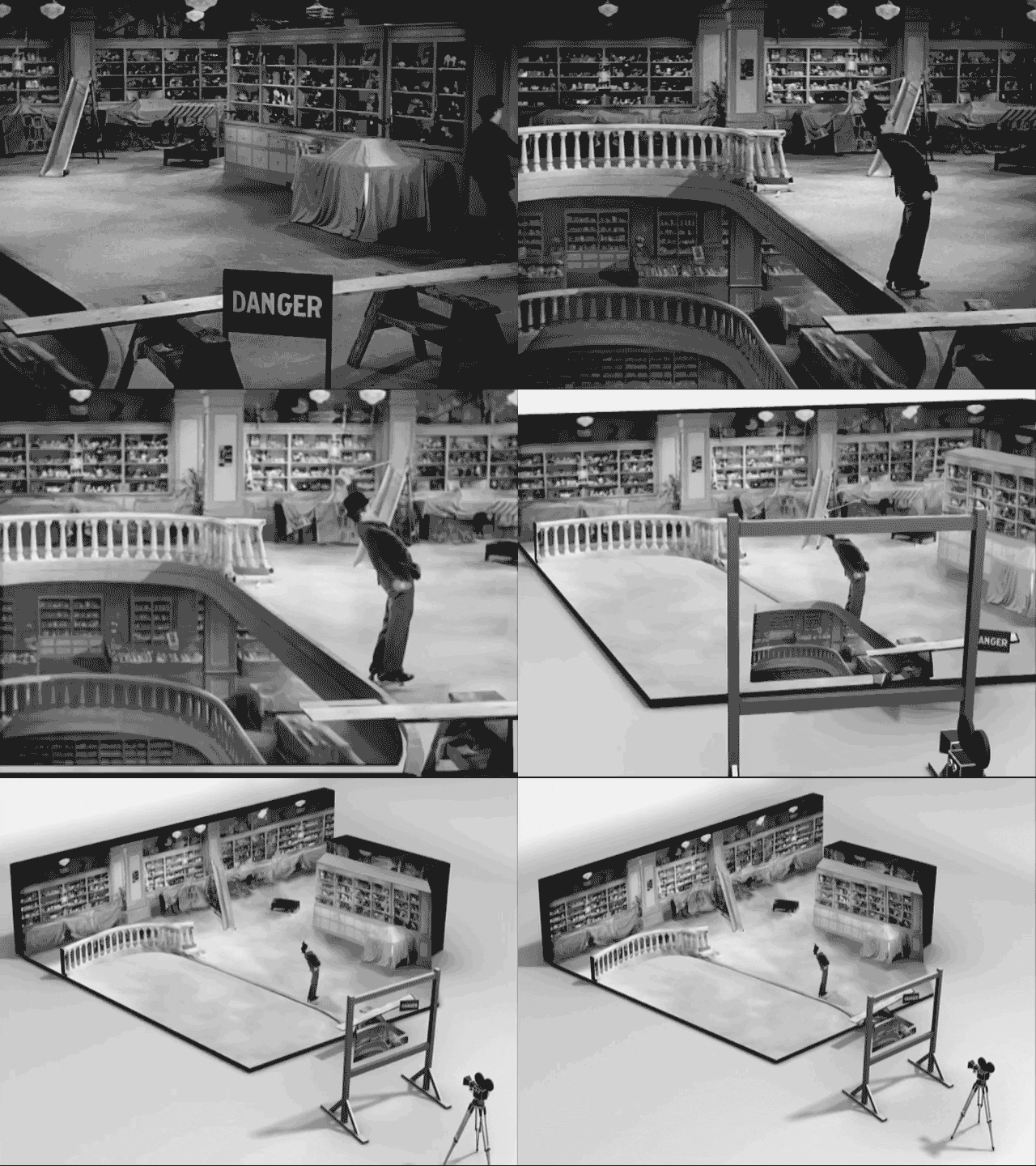
Even Charlie Chaplain used optical illusion in order to create a scene and tell a story in some of his films.

Credit:
https://gfycat.com/obviouseuphorichadrosaurus-chaplin-movies

For the longest time, CGI and special effects cost time, money, and people; and so for a long time, it was kept secure and safe within the realm of mass media and Hollywood.

However, here’s the thing about humans and technology; we’re getting really good and making things smaller and more accessible. We don’t seem to have flying cars and teleporters just yet, but humanity continues to advance technology and expand the realms of what we thought possible.

Rooms of computing power that was used to send people to the moon can now be outdone by a graphic calculator or even the most basic smartphone. And what was once available only to the elite and big-budget studios of the film industry can now be reproduced on a singular desktop computer.

All of this is to talk about the idea of Deep Fakes, or the processing of using machine learning and neural networks in order to create false videos and imagery.

So what is a Deep Fake?

What essentially happens here is that a neural network, or an advanced computer system, can aggregate and collect hundreds of pieces of images and video of an individual or an object, and using that data, create a new image that approximates the data without copying it.

Essentially, a computer that has hundreds of photos of a famous politician can look at all the different expressions and features of a politician, and create an “average” image out of that database. The more photos and video, the more realistic it can appear.

Here’s an example of how Jordan Peele used a neural network in order to give former President Obama some words of his own.

Credit: Buzzfeed Video

A “Deep Fake” can also be used to create fake audio, as illustrated by the “A Stable Genius” YouTube channel, which uses an algorithm in order to create humorous explanations from the current U.S. President Donald Trump.

So most of the examples that I’ve shown you are either humorous or entertaining; and for the most part, that’s what people have been using them for. If nothing else, the generation of new memes has driven a lot in terms of social progress.

The Ugly Side of Fake

It’s easy to imagine what a problem that fake audio and video can pose to Public Relations and the truth-telling community as a whole. And while many people think of Deep Fakes in memes and funny videos, Deep Fakes were actually given their name when a Reddit User named “DeepFake”, began using a network to post fake pornographic video, superimposing celebrities faces onto hardcore pornography.

Revenge porn, copyright, defamation, evidence tampering, political propaganda, misinformation in general. The list of things that Deep Fakes could be used for is only limited by the imagination, and now to those with a powerful enough computer.

This means it will only become harder for Public Relations professionals and journalists to sort out what is real and what’s not. PR professionals now not only have to worry about what is coming out of their organization, but what could be put out there by other individuals/organizations about them, making it appear like it’s their own doing.

While some of these examples are more obvious, how hard will it be to pick out a face digitally altered in a crowd, or perhaps a video of a foreign politician’s words in another country? Maybe someone uses Deep Fakes to create damaging video or audio of an organization they don’t like and leaks it as if it’s real? How often has attempting to deny something worked successfully for PR agencies?

For the longest time, the common phrase “pics or it didn’t happen” has been the guiding mentality of much of modern culture. Back up what you’re saying with photos, video and media content and people are more likely to listen and believe you.

But now it’s going to take a new approach to PR; in my opinion, a more aggressive approach in order for PR professionals to protect the name and credibility of whatever organization they represent. It will no longer be enough for people to sit on the sidelines and deflect when things happen. PR professionals need to be less reactionary and more pro-active in order to ensure that Deep Fakes and similar technology doesn’t work against them.

Deep Fakes are still a work in progress and aren’t as easy as just taking a photo and adding a filter, but they’re getting better and better. It’s important for PR professionals to be able to look at these types of developing trends and anticipate and guard against them.

But for now, here’s one more Deep Fake of Steve Buscemi face on Jennifer Lawrence.

Want to know more about Deep Fakes?
Check out this “Quick-Take” from Bloomberg below.

Or check out the article below from the Guardian.

You thought fake news was bad? Deep fakes are where truth goes to die
https://www.theguardian.com/technology/2018/nov/12/deep-fakes-fake-news-truth



Field of Flowers, Field of Thorns

Who likes flowers?

They’re nice, they’re colorful, and they smell really good. There’s often lots of BEES.

animal bee bloom blooming
Which is a good or a bad thing depending on your viewpoint of bees. (Photo by Pixabay on Pexels.com)

And it’s a beautiful site to see a rainbow of flowers growing in someone’s backyard or in the countryside.

But who likes weeds? They’re hard to get rid of, they can ruin other plants, they’re usually not very good looking, and sometimes they can even hurt you if you touch or step on them the wrong way.

That’s why people often have gardens. To grow the pretty and useful plants they want and keep out the bad ones. Its nature, domesticated, and a beautiful yard can be the pride of the neighborhood.

But what happens to the weeds that are left neglected? They often run rampant through the countryside or woods, spread across the ground and choking out the flowers and other plants that just want to grow and engage in the amazing process of

spongebob-photosynthesis
(Source: Spongebob Television. Artist Rendering by: Angela Natividad)

You might wonder what any of this has to do with the internet or communications, and maybe I’m going metaphor crazy, but take the image I just describe, and instead of a garden, think about Facebook or Twitter. The internet is the land and the people are the plants.

This all relates to the topic of the “digital divide”, a fancy term for those who have access to technology, and those that don’t. There’s been a lot of talk of how the digital divide segregates people on the internet. More and more digital assets are being put behind paywalls and memberships. Virtual gated communities or private digital gardens are emerging; and as much as many don’t want to admit it, the age of the free internet seems to be slowly dying, and now that people have realized there’s money to be had online, companies and businesses are eager to commercialize it.

Amazon Prime, Spotify Premium, Hulu, Netflix, Crunchyroll, Reddit Gold, PlayStation Plus, Xbox Gold. Everything has a membership and a cost these days.

Free is becoming “freemium”, if not premium, and everything is becoming pay-to-play.

In my mind, one of the best examples of the digital divide and an internet freemium economy is within the world of video games. More and more people are being separated between loot boxes and customization items. Those who can afford to purchase custom skins and weapons treat those who can’t afford it differently. Some games are even allowing you to purchase in-game progress instead of earning it through battle.

Companies are teaching people that the easiest and fastest way to overcome a problem or obstacle is to throw money at it.

If you can afford it, great, welcome to the new digital utopia. Your own personal private garden curated of all the flowers you want and all the weeds you don’t.

But what if you can’t?

A culture is rising of the internet “poor”. Those who can’t access or utilize the internet’s best because they either can’t afford it or can’t understand it. As popular social media platforms are becoming more and more discerning of what’s allowed on their platform, more and more people on the disadvantaged side of the digital divide are falling to the wayside. Alongside those virtual private gardens are digital plots of dirt.

Many people criticize social media platforms as a contributor to this problem. But is social media really the bad guy? (aside from all the privacy and data selling concerns…)
Many people bring up the issue of freedom of speech when it comes to social media.

Why can’t I say what I want, when I want to?” “What about my cabbages!” “What right does [insert website here] have to control my content?”

These are fair questions, but a lot of people seem to forget that it’s not their personal garden or playground. Those platforms are responsible for what people say and do on them. Social media isn’t a private garden, it’s a community garden; they own the land and we just plant what we want. But as owners of the land, they can set rules and boundaries as to what’s allowed to grow and what’s not.

But while their business model is letting people choose what they want to grow (or communicate), we’re all very quick to pick up our internet pitchforks and torches whenever someone else says or grows something that we don’t like.

“How could you let this person say these things?” “How come you’re not shutting down this page? Who eats Brussels sprouts?! Don’t you SEE what they’re putting out there?!”

When you get these two extremely polarizing sides shouting at a platform, the platform is going to do what’s best for its business. So what happens to those individuals who say things that others don’t like and get forced off those mainstream platforms?

They make their own platform or community garden and grow whatever they want. Brussels sprouts, eggplant, mushrooms, you name it.

These days, anyone can create a social platform, or a website, or a blog to talk about whatever they want to talk about. They’re more than welcome to. They won’t have the polish, or support, or capabilities that larger platforms like Facebook and Twitter do, but they’ll have less restrictions and be beholden to less as well. The internet allows everybody to grow their audience and message, radicals and moderates alike. All you have to do is a pick a plot of digital land and start planting.

Because we have so many community gardens with their own rules on what you can and can’t grow, the social rejects from pretty mainstream platforms are forced to create their own platforms, or congregate in areas where they’re less controlled or more accepted. And that’s how you end up with a barren plot of dirt or an overgrown garden of weeds. What choice do these individuals have other than to group together with like-minded outcasts?

Social radicalism is all over the internet, just like in real life. But unlike real life, it’s seems a lot more socially acceptable/visible to stuff it all in one dark corner. And when you have these concentrated pockets of radicalism or socially unaccepted viewpoints across the internet, it looks a lot worse than when they’re diluted in the general digital space. It’s hard to spot a thorn in a field of flowers.

A lot of people talk a lot about how “the internet” is allowing these places to exist and how “the internet” creates these negative effects.

But the internet is just a tool, it’s just the dirt that we grow on. What we grow there is our own decision. We are creating our own Frankenstein’s monster. When we perpetuate a culture of “the internet can be what I want, when I want”, a lot of people will stuff the things they “don’t want” into the closet and try to forget about it. They’ll put a fence up and say that it’s not their problem. But we have to take some share of the blame for the rise of these radical eggplant growing internet gardeners.

They're like spongy and flavorless. Ick.
Seriously, I think they’re gross. (Source: https://commons.wikimedia.org)

Don’t get me wrong, I’m not excusing radical social behavior or saying that it’s acceptable by any means (although I’m not a huge fan of eggplant). But I’d feel wrong if I said that we don’t contribute to part of the problem. There is no cyber police force to monitor all of the internet and what happens on it. The FCC and China can try, but the internet transcends national law and regional culture.

As I may have mentioned in earlier posts, the internet is a platform and a hub, it’s a launching point for everyone, both the “crazy” and the “sane”. It’s up to us as citizens of the internet to monitor it and moderate it ourselves. And when we choose not to deal with the radical and choose to build walls and fences around undesirable behavior, all we’re doing is emboldening the problem and letting it grow and grow until it spills over our walls in a much worse than it originally stated.

You know what’s worse than misinformation or hateful thoughts? Misinformation and hateful thoughts that have been fermenting in a vacuum. When those thoughts are ignored rather than addressed, they work in a vicious circle. And those thoughts become cemented in people’s minds and those minds become harder to change. If you pull the head off of a weed, it’ll continue to grow until you treat the “root” of the problem.

For as long as the internet remains as nebulous and unregulated as it is (and as it should stay), there will always be communities of radicals out there. With how easy it is for everyone to have their own platform, people will continue to work to find ways to foster their message and recruit people to their cause. It may not be through Facebook, Twitter or Instagram, and it may be on something less well known, like Gab or WordPress or even a private subreddit, but it will happen.

There’s nothing wrong with growth, and sometimes unregulated growth can be a good thing. But there’s a difference between a field of weeds and a well-tended garden. And all the free land up for grabs out there will continue to allow for all kinds of things to grow:

Good and Bad alike.